

Overview
The Equator Principles (EPs) are a voluntary set of risk management guidelines for financial institutions, developed by Equator Principles Limited based on the sustainability policies and guidelines of the International Finance Corporation (IFC) and the World Bank.
They provide a framework for financial institutions to assess and manage environmental and social risks associated with project financing.
For more information, please visit the official website:
https://equator-principles.com/Governance Framework
In alignment with its commitment to sustainable development, the Bank of Taiwan formally adopted the Equator Principles in May 2022. In accordance with the EP framework, the Bank has established internal policies and procedures to integrate the principles into its credit evaluation and approval processes.
By strengthening environmental and social risk management mechanisms, the Bank aims to enhance its overall ESG risk management effectiveness and work collaboratively with clients to promote sustainable development.
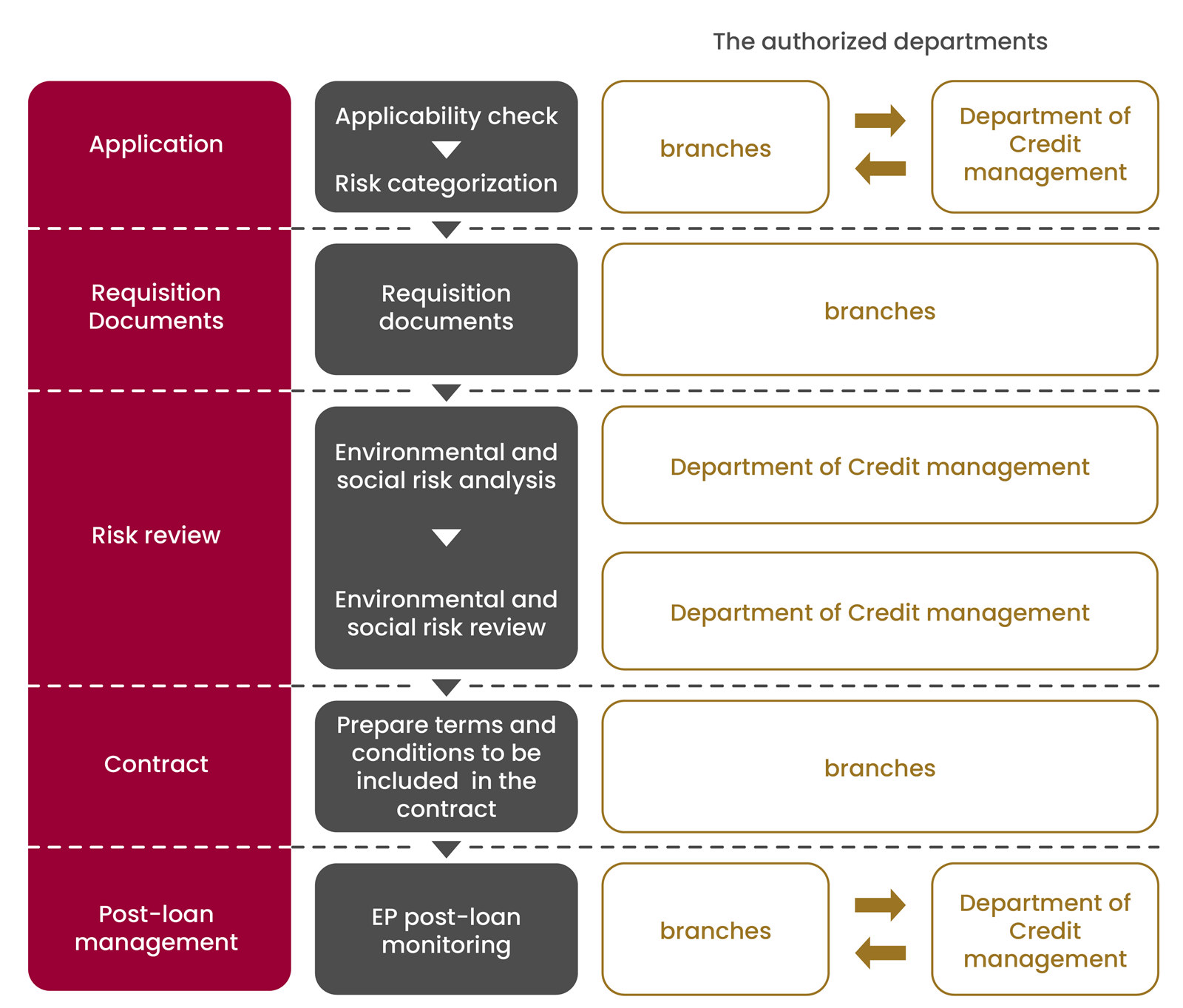
Credit process for EP projects
Training and Capacity Building
To enhance understanding and implementation of the Equator Principles, the Bank of Taiwan incorporates sustainability-related courses into its annual credit training programs. These programs cover the operational procedures and practical applications of the Equator Principles, helping employees improve their ability to identify and manage environmental and social risks.
In addition, the Bank actively participates in regional financial institution meetings and webinars organizedunder the Equator Principles framework, further deepening its expertise through professional exchanges and practical insights on ESG-related topics.
2025 Equator Principles Cases Reporting
Project Finance Advisory
| Total Number of cases | 0 |
|---|---|
| Sector | |
| Mining | 0 |
| Infrastructure | 0 |
| Oil & Gas | 0 |
| Power | 0 |
| Others | 0 |
| Region | |
| Americas | 0 |
| Europe, Middle East & Africa | 0 |
| Asia Pacific | 0 |
Project Finance
| Total Number of cases | A | B | C |
|---|---|---|---|
| 2 | 3 | 0 | |
| Sector | |||
| Mining | 0 | 0 | 0 |
| Infrastructure | 0 | 0 | 0 |
| Oil & Gas | 0 | 0 | 0 |
| Power | 2 | 3 | 0 |
| Others | 0 | 0 | 0 |
| Region | |||
| Americas | 0 | 0 | 0 |
| Europe, Middle East & Africa | 0 | 0 | 0 |
| Asia Pacific | 2 | 3 | 0 |
| Country Designation | |||
| Designated Country | 0 | 0 | 0 |
| Non-Designated Country | 2 | 3 | 0 |
| Both | 0 | 0 | 0 |
| Independent Review | |||
| Yes | 2 | 3 | 0 |
| No | 0 | 0 | 0 |
.Project-related Refinance & Project-related Acquisition For Project Finance
| Total Number of cases | 0 |
|---|---|
| Sector | |
| Mining | 0 |
| Infrastructure | 0 |
| Oil & Gas | 0 |
| Power | 0 |
| Others | 0 |
| Region | |
| Americas | 0 |
| Europe, Middle East & Africa | 0 |
| Asia Pacific | 0 |
| Country Designation | |
| Designated Country | 0 |
| Non-Designated Country | 0 |
| Both | 0 |
| Independent Review | |
| Yes | 0 |
| No | 0 |
.Project-Related Corporate Loans
| Total Number of cases | A | B | C |
|---|---|---|---|
| 0 | 0 | 0 | |
| Sector | |||
| Mining | 0 | 0 | 0 |
| Infrastructure | 0 | 0 | 0 |
| Oil & Gas | 0 | 0 | 0 |
| Power | 0 | 0 | 0 |
| Others | 0 | 0 | 0 |
| Region | |||
| Americas | 0 | 0 | 0 |
| Europe, Middle East & Africa | 0 | 0 | 0 |
| Asia Pacific | 0 | 0 | 0 |
| Country Designation | |||
| Designated Country | 0 | 0 | 0 |
| Non-Designated Country | 0 | 0 | 0 |
| Both | 0 | 0 | 0 |
| Independent Review | |||
| Yes | 0 | 0 | 0 |
| No | 0 | 0 | 0 |