

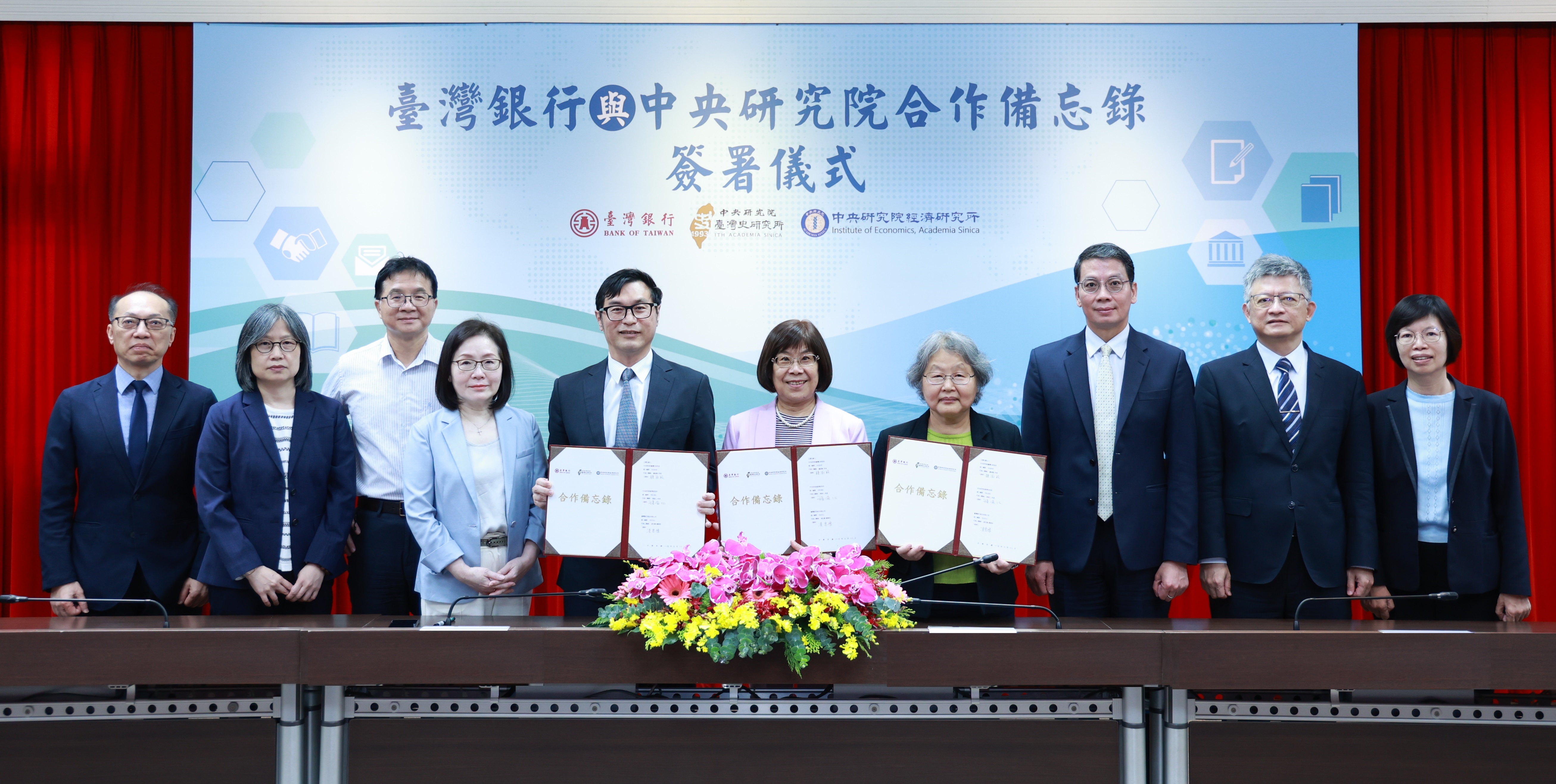
To help unlock the value of precious documents and support in-depth research into Taiwan's history and economic development, the Bank of Taiwan, the Institute of Taiwan History, Academia Sinica (ITH), and the Institute of Economics, Academia Sinica (IEAS) signed a Memorandum of Understanding (MOU) on 18 September, thus establishing a close collaborative relationship between the Bank and the academic community. At the signing ceremony, the Bank was represented by Chairperson Jong-Yuan Ling; ITH was represented by Director Shu-Min Chung; and IEAS was represented by Director Juin-Jen Chang.
The Bank of Taiwan has long held many documents of historic value that attest to Taiwan's financial development as well as its social and economic changes. To reap greater benefits from the preservation, organization, research, and reuse of such documents, and to promote more reciprocal sharing of public resources, the Bank has entered into collaboration with ITH and IEAS with respect to document preservation, academic research, and exchange activities.
Chairperson Ling stated that when the Bank of Taiwan was being established, it took receipt of and organized the documents of the Bank of Taiwan Kabushiki Kaisha. The Bank subsequently collected and published academic studies pertaining to Taiwan's economic, financial, and industrial development. Today, the Bank still has many rare materials of tremendous academic and archival value. Meanwhile, ITH and IEAS both have formidable academic research capabilities. By creating interconnectivity between their own document holdings and those of the Bank, and engaging in interdisciplinary research cooperation between industry and academia, ITH and IEAS will spur increased preservation, organization, and research of historical documents, and will unlock the value of such documents by promoting their increased use. This collaboration will inject new momentum into the study of Taiwan history as well as its economic, financial, and cultural heritage.
As companies work to enhance corporate sustainability, efforts to promote sound social development and build up national strength rest upon the foundation of cultural sustainability. And corporate social responsibility is about more than just promoting economic growth; it also includes a responsibility to preserve historic roots. The Bank of Taiwan, acting in line with its principle of "giving back to society," has long preserved and researched its historic documents, and made them available for public access. Such actions are taken to achieve the Bank's important mission of fulfilling its corporate social responsibilities. By collaboratively supporting academic research and promoting knowledge sharing, the Bank is converting its influence as a financial institution into a concrete program that preserves cultural assets and cultivates public knowledge, thereby demonstrating the Bank's deep appreciation of and commitment to Taiwan's historical memory, cultural sustainability, and the preservation of its heritage for future generations.